Todo en verde. Poder prescindir de la IA no es tenerla bajo control
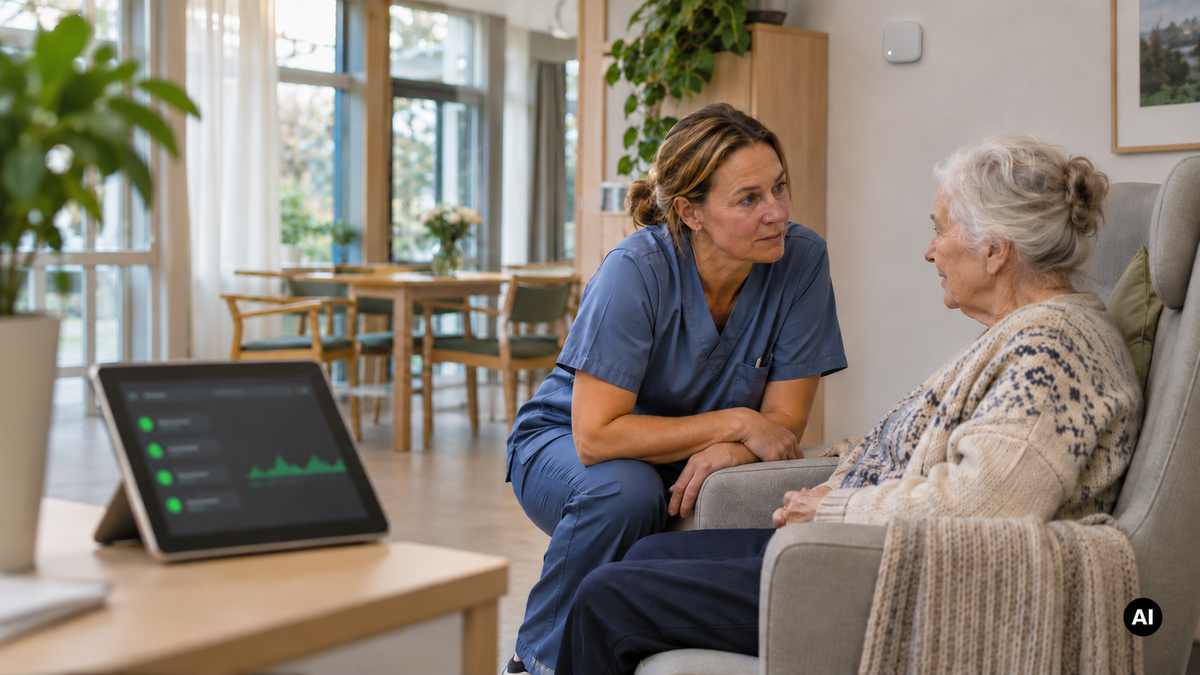
Todas las amenazas identificadas habían acabado en verde. Así concluía la evaluación de riesgos de un municipio danés que la autoridad de protección de datos, Datatilsynet, examinó en su resolución sobre el uso de IA en una residencia de mayores de Faaborg-Midtfyn, publicada el 30 de octubre de 2026. En esa evaluación había, además, una previsión tranquilizadora. El sistema no se consideraba crítico porque, si dejaba de estar disponible, el personal podía volver a sus rutinas conocidas.
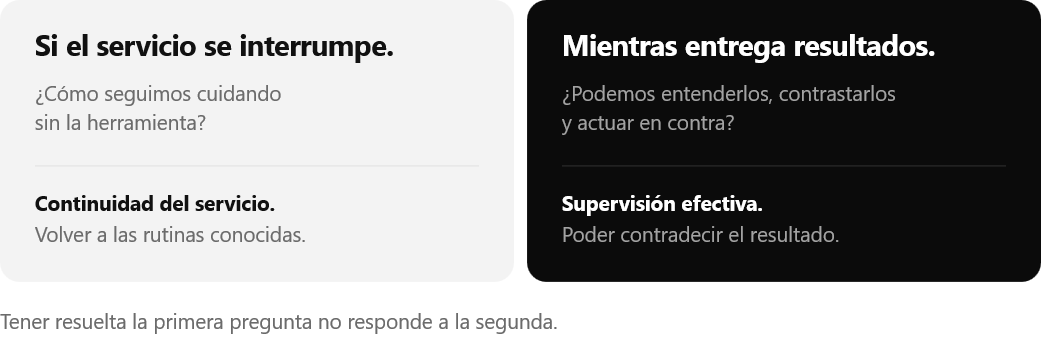
La previsión era razonable. Los cuidados no debían depender de que una herramienta siguiera conectada. Pero resolvía qué hacer sin IA, no cómo trabajar con ella. Una organización puede estar preparada para continuar cuando el sistema se apaga y no haber estudiado cómo evitar que sus profesionales confíen demasiado en él mientras sigue funcionando.
La herramienta se había utilizado durante una prueba de seis meses, con dieciocho residentes, que terminó a finales de enero de 2026. Ese mismo mes, Datatilsynet abrió el caso de oficio, dentro de su atención al uso de IA para vigilar a personas que reciben cuidados. Según la descripción municipal, analizaba movimientos mediante IA y cámaras; y ofrecía información sobre sueño, inquietud y respiración. Se pretendía prevenir caídas y apoyar las valoraciones del personal. No era, por tanto, una herramienta ajena a los cuidados. Su utilidad consistía precisamente en proporcionar información que pudiera influir en ellos.
La evaluación del Ayuntamiento agrupaba las amenazas en seis familias, desde la documentación jurídica hasta la conducta de los empleados o la configuración técnica. Todas recibieron una calificación baja, pese a las distintas puntuaciones de probabilidad y consecuencia. Datatilsynet no pudo reconstruir por qué. Como todo salía en verde, el propio método no llevó a adoptar medidas de mitigación, y el Ayuntamiento tampoco había considerado necesario realizar una evaluación de impacto relativa a la protección de datos (EIPD).
La autoridad formuló una crítica grave (alvorlig kritik, la amonestación más severa por debajo de órdenes y sanciones) por las deficiencias de la evaluación y la falta de EIPD; la resolución no impone una multa. Pero lo que interesa aquí es lo que aquella evaluación había dejado sin estudiar. Según la autoridad, el personal podía atribuir a la valoración de la IA más importancia que a su propio juicio. Ese es el sesgo de automatización, y no se combate demostrando que sabemos volver al procedimiento anterior cuando el servicio se interrumpe.
En un sistema de avisos, que no aparezca una alarma no acredita por sí solo que la persona esté bien. Puede no haber un suceso que detectar, pero también puede haberse omitido una detección. Si el personal encuentra señales preocupantes, necesita poder actuar sin esperar a que la herramienta las confirme. La resolución no relata un accidente por haber confiado en el sistema. Señala que ese riesgo no se había evaluado suficientemente. La diferencia importa porque permite intervenir antes de que exista un daño que contar.
Antes de seguir, una advertencia: la resolución aplica el RGPD, no el Reglamento de IA (RIA), y lo que describe no basta para clasificar ese sistema conforme al RIA. Tiene, eso sí, rasgos que apuntan al alto riesgo. Por ejemplo, el borrador de directrices de la Comisión sobre clasificación de sistemas de IA de alto riesgo (mayo de 2026) cita como tal un sistema que deduce datos de salud a partir de la forma de moverse de los pacientes y los asigna a categorías. Todo dependería, entre otras cosas, de su finalidad declarada. No obstante, el «alto riesgo» que obliga a una EIPD conforme al RGPD no equivale al de un sistema de alto riesgo del RIA. Aun así, el RIA ayuda a ver el problema, porque trata la supervisión humana como algo más que la presencia de alguien al final del proceso. Para los sistemas de alto riesgo, el artículo 14.4.b) contempla expresamente el sesgo de automatización, en particular cuando el sistema aporta información o recomendaciones para que una persona decida. Presentar la IA como «apoyo al profesional» describe justamente la relación en la que ese riesgo aparece.
El mismo artículo va más allá de la conciencia del riesgo pues exige que las medidas de supervisión permitan, según proceda y de manera proporcionada, entender las capacidades y limitaciones del sistema, interpretar sus resultados, descartarlos, invalidarlos o revertirlos y, cuando corresponda, interrumpir el funcionamiento de forma segura. Una advertencia que diga «el resultado debe ser revisado por un profesional» no le proporciona por sí sola los medios para hacerlo.
Para que esa posibilidad técnica se convierta en una supervisión real, hace falta también organizar el trabajo. El artículo 26.2 del RIA prevé que quien despliega un sistema de alto riesgo encomiende esa supervisión a personas con competencia, formación y autoridad. Un supervisor necesita autoridad para cambiar lo que sucede, y esa autoridad sirve de poco si el producto le impide comprender o contradecir sus resultados. La supervisión depende del encuentro entre lo que permite la herramienta y lo que permite el trabajo.
Además, esas obligaciones todavía no se aplican. Tras el Omnibus Digital (Reglamento (UE) 2026/1744), las de los sistemas de alto riesgo no serán aplicables, según el tipo de sistema, hasta el 2 de agosto de 2028 o hasta el 2 de diciembre de 2027, conforme al calendario reformado del RIA. Utilizo sus reglas de supervisión para concretar el problema, no para atribuir al Ayuntamiento una obligación que no le era exigible en aquel piloto. Distinto es el artículo 4, aplicable desde febrero de 2025 a cualquier responsable del despliegue, sea cual sea el riesgo del sistema. Este artículo obliga a adoptar medidas de alfabetización en IA del personal, teniendo en cuenta el contexto y las personas sobre las que se utiliza. Ahí está, también fuera del alto riesgo, la base para enseñar a los profesionales cuándo no fiarse del resultado.
El aplazamiento de esas obligaciones no deja el riesgo pendiente de una fecha futura. El artículo 35 del RGPD ya exige una EIPD previa cuando sea probable que el tratamiento entrañe un alto riesgo para las personas. Datatilsynet consideró decisiva la combinación de nueva tecnología, datos especialmente protegidos y residentes vulnerables. Evaluar cómo la información del sistema podía influir en la atención formaba parte del problema de protección de datos, que va más allá de impedir accesos indebidos a la información. El RIA permite ver con más precisión qué habría que examinar al hablar de control humano.
Dicho todo esto, hay buenas razones para querer utilizar estas herramientas. Una detección adecuada puede acelerar el auxilio y una monitorización bien diseñada podría evitar interrupciones innecesarias del descanso. La cuestión no es conservar el procedimiento anterior por principio, sino comprobar qué mejora la tecnología y qué nueva dependencia introduce al hacerlo.
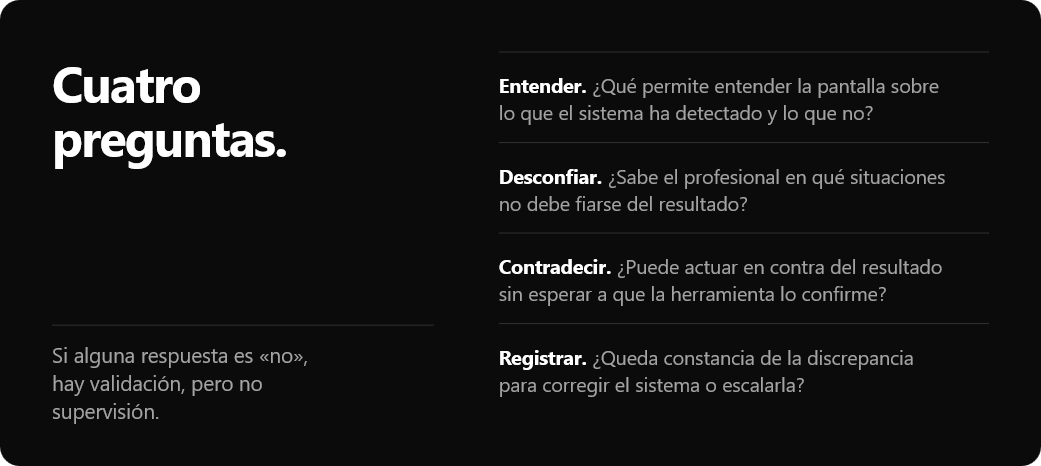
Por eso, antes de dar por resuelta la supervisión, propondría ensayar una discrepancia concreta entre la información de la herramienta y una observación del personal. Bastarían cuatro preguntas: qué permite entender la pantalla sobre lo que el sistema ha detectado y lo que no; si el profesional sabe en qué situaciones no debe fiarse del resultado; si puede actuar en contra de él sin esperar a que la herramienta lo confirme; y cómo queda registrada la discrepancia para corregir el sistema o escalarla. Esto no exige que el supervisor vuelva a calcular el modelo ni que acierte siempre. Permite distinguir una revisión que puede modificar la atención de una validación que solo confirma lo que propone el sistema.
El plan para volver a las rutinas conocidas sigue siendo útil. Lo que cambia es que ya no podemos utilizarlo como respuesta a una pregunta distinta. En la próxima evaluación, saber quién actúa cuando se cae el servicio no debería impedirnos comprobar quién puede llevarle la contraria cuando sigue funcionando.
All green. Being able to do without AI does not mean having it under control
All the identified threats had been classified as low risk. This was the conclusion of the risk assessment carried out by a Danish local authority, which the data protection authority, Datatilsynet, examined in its decision on the use of AI at a care home in Faaborg-Midtfyn, published on 30 October 2026. That assessment also contained a reassuring provision. The system was not considered critical because, should it become unavailable, staff could revert to their familiar routines.
This assessment was reasonable. Care should not depend on a tool remaining online. However, it addressed what to do without AI, not how to work with it. An organisation may be prepared to carry on when the system goes down, yet have failed to consider how to prevent its staff from relying too heavily on it whilst it is still functioning.
The tool had been used during a six-month trial involving eighteen residents, which ended in late January 2026. That same month, Datatilsynet opened an ex officio investigation as part of its scrutiny of the use of AI to monitor people receiving care. According to the council’s description, it analysed movements using AI and cameras, and provided information on sleep, restlessness and breathing. The aim was to prevent falls and support staff assessments. It was not, therefore, a tool unrelated to care. Its usefulness lay precisely in providing information that could influence care provision.
The council’s assessment grouped the risks into six categories, ranging from legal documentation to staff behaviour and technical configuration. All were given a low rating, despite varying scores for likelihood and impact. Datatilsynet was unable to ascertain why. As everything was flagged as ‘green’, the method itself did not lead to the adoption of mitigation measures, and the City Council had not considered it necessary to carry out a data protection impact assessment (DPIA).
The authority issued a serious criticism (alvorlig kritik, the most severe reprimand short of orders and sanctions) for the shortcomings in the assessment and the lack of a DPIA; the decision does not impose a fine. But what is of interest here is what that assessment had failed to examine. According to the authority, staff might have attached greater importance to the AI’s assessment than to their own judgement. This is known as automation bias, and it cannot be countered simply by demonstrating that we know how to revert to the previous procedure when the service is disrupted.
In an alert system, the absence of an alarm does not in itself prove that the person is well. There may be no incident to detect, but a detection may also have been missed. If staff notice worrying signs, they need to be able to act without waiting for the tool to confirm them. The report does not attribute an incident to reliance on the system. It points out that this risk had not been adequately assessed. The distinction matters because it allows intervention before any harm occurs.
Before continuing, a word of warning: the decision applies the GDPR, not the AI Regulation (AI Reg), and what it describes is not sufficient to classify that system as high-risk under the AI Reg. It does, however, have features that point to high risk. For example, the Commission’s draft guidelines on the classification of high-risk AI systems (May 2026) cite as such a system that infers health data from the way patients move and assigns them to categories. Everything would depend, amongst other things, on its stated purpose. However, the ‘high risk’ that triggers a DPIA under the GDPR is not equivalent to that of a high-risk system under the RIA. Even so, the RIA helps to highlight the problem, because it treats human oversight as more than just the presence of someone at the end of the process. For high-risk systems, Article 14(4)(b) expressly addresses automation bias, particularly where the system provides information or recommendations for a person to make a decision. Presenting AI as ‘support for the professional’ accurately describes the relationship in which this risk arises.
The same article goes beyond mere awareness of the risk, as it requires that oversight measures enable, as appropriate and in a proportionate manner, an understanding of the system’s capabilities and limitations; the interpretation of its results; and the ability to disregard, invalidate or reverse them; and, where necessary, to safely halt its operation. A warning stating ‘the result must be reviewed by a professional’ does not, in itself, provide the means to do so.
For that technical possibility to become genuine supervision, the work must also be organised. Article 26.2 of the RIA stipulates that whoever deploys a high-risk system must entrust that supervision to competent, trained and authorised persons. A supervisor needs the authority to change what is happening, and that authority is of little use if the product prevents them from understanding or challenging its results. Supervision depends on the interplay between what the tool allows and what the work requires.
Furthermore, these obligations are not yet in force. Following the Digital Omnibus (Regulation (EU) 2026/1744), those relating to high-risk systems will not apply, depending on the type of system, until 2 August 2028 or until 2 December 2027, in accordance with the revised RIA timetable. I am using these supervisory rules to clarify the issue, not to attribute to the City Council an obligation that was not required of it in that pilot scheme. Article 4 is a different matter; it applies from February 2025 to any party responsible for deployment, regardless of the system’s risk level. This article requires the implementation of AI literacy measures for staff, taking into account the context and the individuals on whom the system is used. Therein lies the basis – even outside the high-risk category – for teaching professionals when not to trust the outcome.
The postponement of these obligations does not leave the risk pending for a future date. Article 35 of the GDPR already requires a prior data protection impact assessment (DPIA) where the processing is likely to result in a high risk to individuals. Datatilsynet considered the combination of new technology, specially protected data and vulnerable residents to be decisive. Assessing how information from the system might influence care was part of the data protection issue, which goes beyond preventing unauthorised access to information. The RIA allows us to see more precisely what needs to be examined when discussing human oversight.
Having said that, there are good reasons for wanting to use these tools. Effective detection can speed up the provision of assistance, and well-designed monitoring could prevent unnecessary interruptions to residents’ rest. The issue is not to retain the previous procedure on principle, but to ascertain what improvements the technology brings and what new dependencies it introduces in the process.
Therefore, before considering the monitoring issue resolved, I would suggest testing a specific discrepancy between the tool’s data and an observation made by staff. Four questions would suffice: what does the screen reveal about what the system has detected and what it has not; does the professional know in which situations they should not rely on the result; can they act contrary to it without waiting for the tool to confirm it; and how is the discrepancy recorded so that the system can be corrected or the matter escalated? This does not require the supervisor to recalculate the model or to be correct every time. It allows us to distinguish between a review that may alter the course of care and a validation that merely confirms what the system proposes.
The plan to return to familiar routines remains useful. What has changed is that we can no longer use it as an answer to a different question. In the next assessment, knowing who takes action when the service fails should not prevent us from checking who can challenge the system when it is still functioning.