PEGI 16 y lootboxes. Cuando la etiqueta de edad puede decidir qué se vende dentro de un videojuego

La propuesta de Ley de Equidad Digital (Digital Fairness Act) de la Comisión Europea prohibiría ofrecer lootboxes y mecánicas pay-to-win a menores en los videojuegos «dirigidos a menores», y la clasificación PEGI puede ser el indicio que lo determine.
El 25 de septiembre de 2026 salió a la venta EA Sports FC 27, el que todos conocemos como “el FIFA”, con una etiqueta distinta de la de sus predecesores. FC 24, FC 25 y FC 26 figuran en la base de datos de PEGI como aptos para todas las edades, con un PEGI 3; los dos últimos, con el aviso de que incluyen artículos aleatorios de pago. FC 27 llegó con un PEGI 16, y la ficha de PEGI explica el motivo en una línea, que el juego permite comprar cajas de botín. El fútbol era el mismo, y también los sobres de Ultimate Team, esos paquetes que se compran sin saber qué futbolistas traen dentro. Lo que había cambiado era el criterio. Desde junio, PEGI asigna por defecto un PEGI 16 a los juegos nuevos con artículos aleatorios de pago (en algunos casos, un PEGI 18), y desde octubre revisa al alza los juegos solo digitales ya publicados que los incluyen. Era autorregulación, informar mejor a las familias sin prohibir nada.
Casi siete semanas después, el pasado 11 de noviembre, la Comisión Europea presentó la propuesta de Reglamento que en español ha llamado Ley de Equidad Digital (Digital Fairness Act, COM(2026) 1100). Casi todo lo que propone para los videojuegos depende de una expresión, que el producto esté «dirigido a menores», es decir, a personas de menos de 18 años. Y en el considerando 62, dedicado a las monedas virtuales, la Comisión señala que un producto se dirige a menores, por ejemplo, cuando tiene una clasificación por edad que indica que su uso es apropiado para quien no ha cumplido los 18. Un PEGI 16 dice exactamente eso, y FC 27 lo tiene precisamente porque vende lootboxes. La etiqueta que se pensó para orientar a los padres en la tienda puede acabar decidiendo qué se le vende al jugador una vez dentro del juego.
Para quien desarrolla, publica o monetiza un videojuego, la pregunta ya no es si sus sobres son un juego de azar, la discusión de los últimos ocho años en Bélgica, Países Bajos o España, sino si su juego está dirigido a menores.
Dos avisos antes de seguir. El primero, que no parece que Europa vaya a prohibir las monedas virtuales. El segundo, que hoy solo existe la versión inglesa del texto y que sigue siendo una propuesta que todavía tienen que aprobar el Parlamento Europeo y el Consejo, así que las citas que siguen son traducción mía y el contenido está sujeto a cambios.
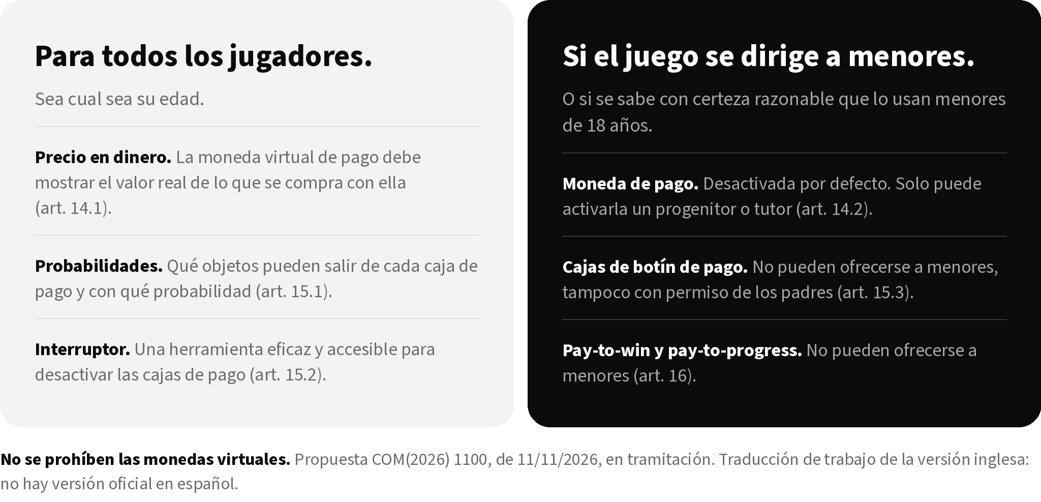
La propuesta trata los videojuegos en dos niveles. El primero vale para todos los jugadores, tengan la edad que tengan. Quien venda moneda virtual de pago tendrá que indicar el valor en dinero de lo que se compra con ella (artículo 14.1). Quien ofrezca cajas de botín, ruletas o sobres de cartas de pago tendrá que informar de qué puede salir y con qué probabilidad, y poner a disposición de los consumidores, de todos ellos, una herramienta eficaz para desactivarlos (artículo 15). El interruptor no es, por tanto, una concesión a los adultos.
El segundo nivel se activa cuando el producto se dirige a menores o cuando el comerciante sabe con certeza razonable que lo usan menores. Ahí la moneda de pago debe venir desactivada por defecto y solo puede activarla un progenitor o tutor (artículo 14.2). Las cajas de pago, en cambio, no pueden ofrecerse a menores, y el texto no prevé ninguna excepción por permiso de los padres (artículo 15.3). Lo mismo ocurre con el pay-to-win (pagar para ganar) y el pay-to-progress (pagar para avanzar), es decir, las compras que son necesarias, o se presentan como necesarias, para avanzar o ganar (artículo 16).
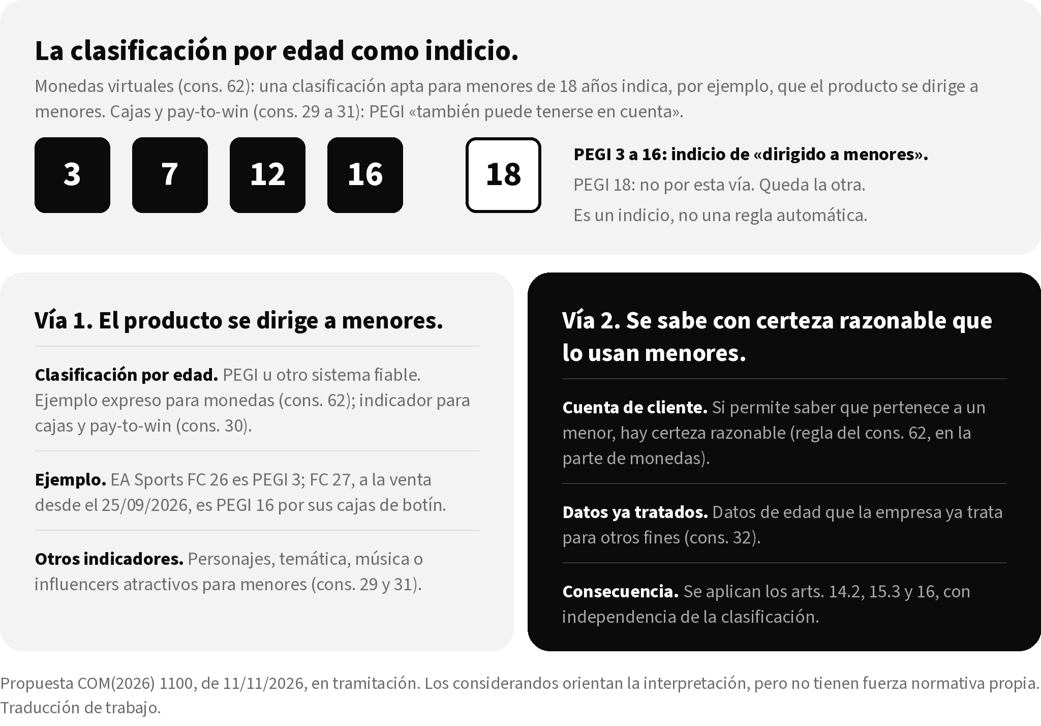
Conviene precisar, eso sí, hasta dónde llega el considerando 62. Está en la parte dedicada a las monedas virtuales. Los considerandos que explican la prohibición de lootboxes y de pay-to-win (64 y 65) repiten la misma fórmula, «dirigido a menores o con certeza razonable de que lo usan menores», pero no remiten a él. Para esas prohibiciones, el criterio es el general de los considerandos 29 a 31, que piden atender a indicadores objetivos y dicen que las clasificaciones como PEGI «también pueden tenerse en cuenta». Es una formulación más débil. Extender el ejemplo del considerando 62 a las lootboxes es una lectura sistemática razonable, porque se trata de la misma expresión en el mismo Reglamento, pero no está escrita.
Y un considerando no es una norma. El Tribunal de Justicia de la UE recuerda que no tiene valor vinculante y que no puede invocarse para interpretar un artículo en un sentido manifiestamente contrario a su tenor (Deutsches Milch-Kontor, C-136/04, apartado 32). Como los artículos no definen qué significa dirigirse a menores, la clasificación será un indicio de peso, no una regla automática.
Tampoco pasar a PEGI 18 cierra la cuestión, porque queda la segunda vía. Es decir, que el comerciante sepa con certeza razonable que lo usan menores. Si el jugador accede con una cuenta de cliente que permite saber que es menor, el considerando 62 da por hecha esa certeza razonable, una regla que de nuevo solo aparece en la parte de monedas. Cuentan además la temática, los personajes o los influencers que hacen atractivo el juego para un público joven, y los datos de edad que la empresa ya trata para otros fines.
Volvamos a FC 27. Según las páginas de ayuda de EA, los FC Points se compran con dinero real; las monedas de Ultimate Team (Coins) se ganan jugando o vendiendo en el mercado de transferencias y no se pueden comprar; y los sobres se obtienen con cualquiera de las dos. EA publica las probabilidades de los sobres que se compran con FC Points, y las cuentas de adolescentes tienen por defecto un límite de gasto de cero que solo un progenitor puede modificar. Ese diseño se parece a la puerta parental del artículo 14.2, pero no resuelve el 15.3, que no admite que los padres autoricen las cajas. En mi lectura, el sobre pagado con FC Points sería una recompensa variable de pago y quedaría prohibido para menores, mientras que el pagado con Coins ganadas jugando, en principio, no.
Hay zonas grises. Las Coins pueden proceder de vender jugadores que salieron de sobres pagados, y los considerandos 64 y 65 hablan de sistemas pagados «en todo o en parte», precisión que la definición del artículo 3.18 no recoge. EA no documenta si un mismo sobre puede pagarse combinando ambas monedas. Y si en los modos competitivos el resultado acaba dependiendo de lo que se gasta, entraría además en juego el artículo 16.
La federación europea de desarrolladores (EGDF) y Video Games Europe calificaron la propuesta el mismo 11 de noviembre de «inviable, injustificada y desproporcionada» y le reprocharon tratar como dirigidos a niños todos los juegos por debajo de PEGI 18, cuando las clasificaciones «indican idoneidad, no público objetivo». Y tienen parte de razón. Un PEGI 16 nunca pretendió decir que un juego se hubiera pensado para adolescentes, solo que no les resulta inadecuado. Pero si la propuesta sale adelante con esta redacción, esa idoneidad pasará a ser un indicio de destinatario, y el resultado tiene algo de circular. La clasificación que sube a PEGI 16 por la presencia de lootboxes es la que, a su vez, ayudaría a impedir que esas cajas se ofrezcan a los menores que pueden jugarlo.
También dicen que se prohíben prácticamente todas las compras de los menores de 18 años. No es exacto, porque la moneda de pago puede activarse con permiso de los padres, y lo llamativo es que su propia contrapropuesta, compras desactivadas por defecto que solo un progenitor pueda activar, coincide casi punto por punto con el artículo 14.2. Más fundada es la queja de que casi cualquier compra podría considerarse pay-to-win, porque hay una zona gris real en los pases de temporada con niveles comprables o en los potenciadores de tiempo. Pero la propuesta habla de compras necesarias, o presentadas como necesarias, y sus ejemplos son de estructura, como barreras artificiales de dificultad o un camino gratuito que se vuelve ilusorio. Una skin estética que no hace falta para avanzar no encaja ahí, aunque una lootbox que reparte skins al azar siga siendo una caja. Lo decisivo no es que la compra se llame pase de batalla, skin o sobre, sino la función que cumple.
Nada de esto es exigible todavía. En España, la Ley 13/2011 de regulación del juego solo alcanza a las lootboxes cuando concurren pago, azar y un premio que pueda convertirse en dinero. El anteproyecto de 2022 sobre mecanismos aleatorios de recompensa no pasó de borrador, y el proyecto de Ley Orgánica de protección de menores en entornos digitales, que en su artículo 5 prohibía a los menores el acceso a estas cajas, ha caducado con la disolución de las Cortes. Quedan la Ley de Competencia Desleal, que ya considera agresiva la exhortación directa a los niños para que compren (artículo 30) y prohíbe las omisiones engañosas, además de los principios sobre monedas virtuales que la Comisión y las autoridades de consumo publicaron en marzo de 2025, que orientan pero no obligan. Ninguno de esos instrumentos prohíbe ofrecer lootboxes a los menores.
Si la propuesta se aprueba, el margen nacional se estrecha. Sería un reglamento de armonización plena, y el Tribunal de Justicia ya dijo de la directiva a la que sustituiría que los Estados no pueden adoptar medidas más restrictivas, «ni siquiera para garantizar un grado más elevado de protección de los consumidores» (VTB-VAB y Galatea, C-261/07 y C-299/07, apartado 52). Queda a salvo la normativa sobre juego de azar. En mi opinión, España podría seguir tratando ciertas cajas como juego si reformara su ley, pero no aprobar por la vía del consumo una prohibición distinta de la europea. No hay, en cualquier caso, jurisprudencia del Tribunal sobre cajas de botín.
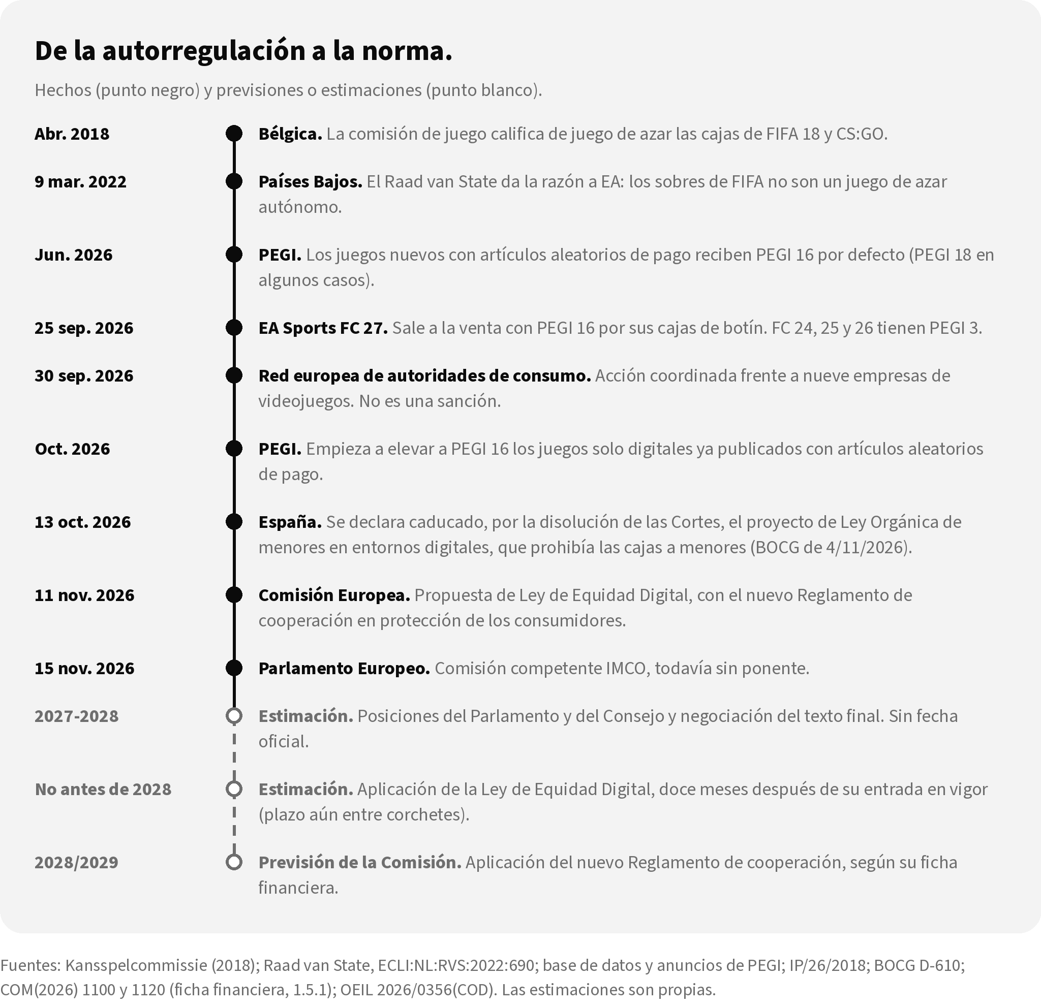
El calendario va despacio. El texto se aplicaría doce meses después de su entrada en vigor, un plazo que todavía figura entre corchetes, y antes tienen que ponerse de acuerdo el Parlamento Europeo y el Consejo. A 15 de noviembre de 2026, la comisión competente en el Parlamento es IMCO y todavía no hay ponente. La ficha financiera del nuevo Reglamento de cooperación entre autoridades de consumo, presentado el mismo día, prevé su adopción en 2027 y su aplicación en 2028 o 2029. Para la Ley de Equidad Digital no hay una previsión equivalente, pero, siendo realistas, no parece que pueda aplicarse antes de 2028. Las multas de hasta el 6 % de la facturación mundial que han acaparado los titulares existen (artículo 35.6), aunque solo puede imponerlas la Comisión, solo a empresas que no sean pymes y solo en infracciones que afecten al menos a dos tercios de los Estados miembros y de la población de la Unión.
Ese plazo no invita a esperar. Da tiempo para responder con datos a unas cuantas preguntas: qué se compra en cada juego con dinero, qué con moneda de pago y qué con moneda ganada jugando, y si el sistema permite distinguirlo; qué contiene cada lootbox y dónde se publican hoy sus probabilidades; qué clasificación tiene cada título en cada tienda; y qué sabe ya la cuenta de cliente sobre la edad del jugador. Esta última merece una conversación propia con el delegado de protección de datos. Los artículos 12 y 13 dicen expresamente que cumplirlos no obliga a tratar datos adicionales para saber si alguien es menor, y los artículos 14 a 16 no lo repiten. Pero el considerando 32 recuerda que, por el principio de minimización del RGPD, el Reglamento no debe llevar a la empresa a obtener o tratar más datos personales de los que ya tiene, y el 48 dice algo parecido sobre la vulnerabilidad. Saber cuáles tiene, y para qué los usa, es el punto de partida.
La etiqueta de FC 27 se pensó para que unos padres supieran qué estaban comprando. Si la propuesta sale adelante tal como está, PEGI ya no solo dirá para quién es apto un juego. Ayudará a decidir qué se le puede vender a quien lo juega. Y en el caso de FC 27, las mismas lootboxes que le subieron el rating PEGI serían las que harían de dicho rating el mayor impedimento para ofrecer a sus jugadores menores de edad.
PEGI 16 and loot boxes. When the age rating can determine what is sold within a video game
The European Commission’s proposed Digital Fairness Act would ban the offering of loot boxes and pay-to-win mechanics to minors in video games ‘aimed at minors’, and the PEGI rating may serve as the determining factor.
On 25 September 2026, EA Sports FC 27 – the game we all know as ‘FIFA’ – went on sale with a different rating to that of its predecessors. FC 24, FC 25 and FC 26 are listed in the PEGI database as suitable for all ages, with a PEGI 3 rating; the latter two include a warning that they contain random paid items. FC 27 was released with a PEGI 16 rating, and the PEGI entry explains the reason in a single line: the game allows players to purchase loot boxes. The football was the same, as were the Ultimate Team packs – those packages you buy without knowing which players they contain. What had changed was the criteria. Since June, PEGI has been assigning a PEGI 16 rating by default to new games featuring random paid items (in some cases, a PEGI 18), and since October it has been upgrading the ratings of previously released digital-only games that include them. It was self-regulation: better informing families without banning anything.
Almost seven weeks later, on 11 November, the European Commission presented the proposed Regulation, known in Spanish as the Digital Fairness Act (COM(2026) 1100). Almost everything it proposes for video games hinges on one phrase: that the product is ‘aimed at minors’, that is, at people under the age of 18. And in recital 62, which deals with virtual currencies, the Commission states that a product is aimed at minors, for example, when it has an age rating indicating that its use is appropriate for those under the age of 18. A PEGI 16 rating says exactly that, and FC 27 has it precisely because it sells loot boxes. The label that was intended to guide parents in the shop may end up determining what is sold to the player once they are inside the game.
For anyone who develops, publishes or monetises a video game, the question is no longer whether their loot boxes constitute a game of chance – the debate that has raged for the past eight years in Belgium, the Netherlands and Spain – but whether their game is aimed at minors.
Two points to note before continuing. Firstly, it does not appear that Europe is set to ban virtual currencies. Secondly, only the English version of the text is currently available, and it remains a proposal that still needs to be approved by the European Parliament and the Council; therefore, the quotations that follow are my own translations and the content is subject to change.
The proposal addresses video games on two levels. The first applies to all players, regardless of their age. Anyone selling virtual currency for a fee will have to state the monetary value of what can be purchased with it (Article 14.1). Anyone offering paid loot boxes, randomised draws or card packs must disclose what items may be obtained and the probability of obtaining them, and must make an effective tool available to all consumers to disable them (Article 15). The opt-out feature is therefore not a concession to adults.
The second level is triggered when the product is aimed at minors or when the trader knows with reasonable certainty that minors are using it. In such cases, the virtual currency must be disabled by default and may only be enabled by a parent or guardian (Article 14.2). Payment boxes, on the other hand, may not be offered to minors, and the text does not provide for any exceptions based on parental consent (Article 15.3). The same applies to ‘pay-to-win’ and ‘pay-to-progress’ – that is, purchases that are necessary, or are presented as necessary, to progress or win (Article 16).
It is worth clarifying, however, the scope of recital 62. It appears in the section on virtual currencies. The recitals explaining the ban on loot boxes and pay-to-win (64 and 65) repeat the same wording, ‘aimed at minors or where there is reasonable certainty that minors will use it’, but do not refer to it. For these prohibitions, the criterion is the general one set out in recitals 29 to 31, which call for consideration of objective indicators and state that classifications such as PEGI ‘may also be taken into account’. This is a weaker formulation. Extending the example in recital 62 to loot boxes is a reasonable systematic interpretation, as it concerns the same wording in the same Regulation, but it is not explicitly stated.
And a recital is not a legal provision. The Court of Justice of the EU points out that it has no binding force and cannot be relied upon to interpret an article in a manner manifestly contrary to its wording (Deutsches Milch-Kontor, C-136/04, paragraph 32). As the articles do not define what it means to be aimed at minors, the classification will be a significant indicator, not an automatic rule.
Nor does a change to PEGI 18 settle the matter, as the second approach remains. That is to say, the trader must know with reasonable certainty that minors are using it. If the player logs in with a customer account that reveals they are a minor, recital 62 takes that reasonable certainty for granted – a rule which, once again, only appears in the section on virtual currencies. Other factors include the theme, characters or influencers that make the game appealing to a young audience, and the age data that the company already processes for other purposes.
Let’s return to FC 27. According to EA’s help pages, FC Points are purchased with real money; Ultimate Team coins are earned by playing or by selling on the transfer market and cannot be purchased; and packs are obtained using either of these. EA publishes the odds for packs purchased with FC Points, and teenagers’ accounts have a default spending limit of zero, which only a parent can change. This design resembles the parental control mechanism in Article 14.2, but does not address Article 15.3, which does not permit parents to authorise the purchase of packs. In my view, a pack paid for with FC Points would constitute a variable payment reward and would be prohibited for minors, whilst one paid for with Coins earned through gameplay would, in principle, not be.
There are grey areas. Coins may come from selling players obtained from paid packs, and recitals 64 and 65 refer to systems paid for ‘in whole or in part’ – a distinction not covered by the definition in Article 3.18. EA does not specify whether a single pack can be purchased by combining both currencies. And if, in competitive modes, the outcome ends up depending on how much is spent, Article 16 would also come into play.
The European Game Developers Federation (EGDF) and Video Games Europe described the proposal on 11 November itself as ‘unworkable, unjustified and disproportionate’ and criticised it for treating all games rated below PEGI 18 as being aimed at children, when the ratings ‘indicate suitability, not target audience’. And they are partly right. A PEGI 16 rating was never intended to mean that a game was designed for teenagers, only that it is not unsuitable for them. But if the proposal goes ahead with this wording, that suitability will become an indication of the intended audience, and the result is somewhat circular. The rating that is raised to PEGI 16 due to the presence of loot boxes is the very one that would, in turn, help prevent those boxes from being offered to minors who are able to play the game.
They also claim that virtually all in-game purchases by under-18s are prohibited. This is not entirely accurate, as in-game currency can be activated with parental consent, and what is striking is that their own counter-proposal – purchases disabled by default and which only a parent can enable – coincides almost point for point with Article 14.2. More valid is the complaint that almost any purchase could be considered pay-to-win, as there is a genuine grey area regarding season passes with purchasable tiers or time-based boosters. But the proposal refers to purchases that are necessary, or presented as necessary, and its examples relate to game structure, such as artificial difficulty barriers or a free path that turns out to be illusory. A cosmetic skin that is not required to progress does not fall into this category, even though a loot box that distributes skins at random remains a loot box. The decisive factor is not whether the purchase is called a battle pass, skin or pack, but the function it serves.
None of this is enforceable as yet. In Spain, Law 13/2011 on the regulation of gambling only covers loot boxes where payment, chance and a prize that can be converted into money are all present. The 2022 preliminary draft bill on random reward mechanisms never progressed beyond the draft stage, and the draft Organic Law on the Protection of Minors in Digital Environments – which, in Article 5, prohibited minors from accessing these boxes – has lapsed following the dissolution of Parliament. What remains is the Unfair Competition Act, which already considers direct exhortation of children to make purchases to be aggressive (Article 30) and prohibits misleading omissions, as well as the principles on virtual currencies published by the Commission and the consumer authorities in March 2025, which provide guidance but are not binding. None of these instruments prohibits the offering of loot boxes to minors.
If the proposal is approved, the scope for national discretion will be narrowed. It would be a fully harmonising regulation, and the Court of Justice has already ruled, with regard to the directive it would replace, that Member States may not adopt more restrictive measures, ‘not even to ensure a higher level of consumer protection’ (VTB-VAB and Galatea, C-261/07 and C-299/07, paragraph 52). Regulations on games of chance remain unaffected. In my view, Spain could continue to treat certain ‘cajas’ as gambling if it were to amend its legislation, but it could not adopt, through consumer law, a ban that differs from the European one. In any case, there is no case law from the Court regarding ‘cajas de botín’.
Progress is slow. The text would apply twelve months after its entry into force – a timeframe that is still shown in square brackets – and the European Parliament and the Council must first reach an agreement. As at 15 November 2026, the relevant committee in Parliament is IMCO and there is still no rapporteur. The financial statement for the new Regulation on cooperation between consumer authorities, presented on the same day, envisages its adoption in 2027 and its application in 2028 or 2029. There is no equivalent provision for the Digital Fairness Act, but, realistically, it does not appear likely to come into force before 2028. The fines of up to 6 per cent of global turnover that have dominated the headlines do exist (Article 35(6)), although they can only be imposed by the Commission, only on companies that are not SMEs, and only for infringements affecting at least two-thirds of the Member States and the Union’s population.
That timeframe does not encourage us to wait. It gives us time to answer a few questions with data: what is purchased in each game using real money, what using in-game currency and what using currency earned whilst playing, and whether the system allows for this distinction; what each loot box contains and where its odds are currently published; what rating each title has in each shop; and what information the customer account already holds regarding the player’s age. This last point warrants a separate discussion with the data protection officer. Articles 12 and 13 expressly state that compliance with them does not require the processing of additional data to determine whether someone is a minor, and Articles 14 to 16 do not reiterate this. However, Recital 32 recalls that, in accordance with the GDPR’s principle of data minimisation, the Regulation must not lead a company to collect or process more personal data than it already holds, and Recital 48 makes a similar point regarding vulnerability. Knowing what data it holds, and what it uses it for, is the starting point.
The FC 27 label was designed to let parents know what they were buying. If the proposal goes ahead as it stands, PEGI will no longer simply indicate who a game is suitable for. It will help determine what can be sold to those who play it. And in the case of FC 27, the very same loot boxes that raised its PEGI rating would be the very reason why that rating becomes the biggest obstacle to offering the game to its underage players.