Lo que sale de tu cabeza. La primera sanción de la AEPD sobre neurodatos

La Agencia Española de Protección de Datos ha sancionado a Bitbrain, una empresa zaragozana de neurotecnología, por cómo trataba los electroencefalogramas de los voluntarios de sus estudios de neuromarketing, y aunque no la sanciona por tratar categorías especiales de datos, deja escrito que lo que esas métricas miden son inferencias sobre estados mentales.
«No se tratan datos de categorías especiales.» Así terminaba la lista de datos de la política de privacidad que Bitbrain entregaba a quienes se apuntaban a sus estudios de neuromarketing. La hoja informativa explicaba el resto. El voluntario vería varios vídeos y anuncios durante alrededor de una hora, con un anillo en la mano para registrar la respuesta de la piel y el pulso, y una diadema en la cabeza para registrar la señal cerebral. De esa señal salían cuatro métricas, la valencia afectiva, el engagement (la implicación con lo que se ve), la carga de trabajo y la memorización. La primera, por ejemplo, compara la actividad de dos zonas frontales del cerebro, una asimetría que, según la propia empresa, la literatura científica relaciona con emociones positivas o negativas.
La resolución PS/00013/2026, que la AEPD publicó el 12 de noviembre de 2026, no dice lo contrario de aquella frase. No imputa a Bitbrain el tratamiento ilícito de categorías especiales. Pero tampoco la da por buena. Para la Agencia, esas métricas «no constituyen meros indicadores técnicos, sino que implican la inferencia de estados mentales, emocionales y cognitivos» a partir de señales fisiológicas o neuronales, y pueden revelar información sobre la salud o el funcionamiento cognitivo de la persona (página 44). Es la primera resolución sancionadora de la Agencia centrada en neurodatos (los datos que proceden de la actividad del cerebro o del sistema nervioso, y lo que se infiere de ellos). No consta ninguna resolución anterior de la AEPD sobre electroencefalografía o neurotecnología, aunque la propia Agencia no la ha presentado como tal.
Un aviso antes de seguir. Se trata de una terminación por reconocimiento de responsabilidad y pago voluntario. Bitbrain pagó y no presentó alegaciones, así que los hechos y su calificación son los del acuerdo de inicio, sin el contraste que habría tenido un procedimiento completo. La resolución, además, no indica cuándo se notificó, y no hay constancia pública de que se haya recurrido.
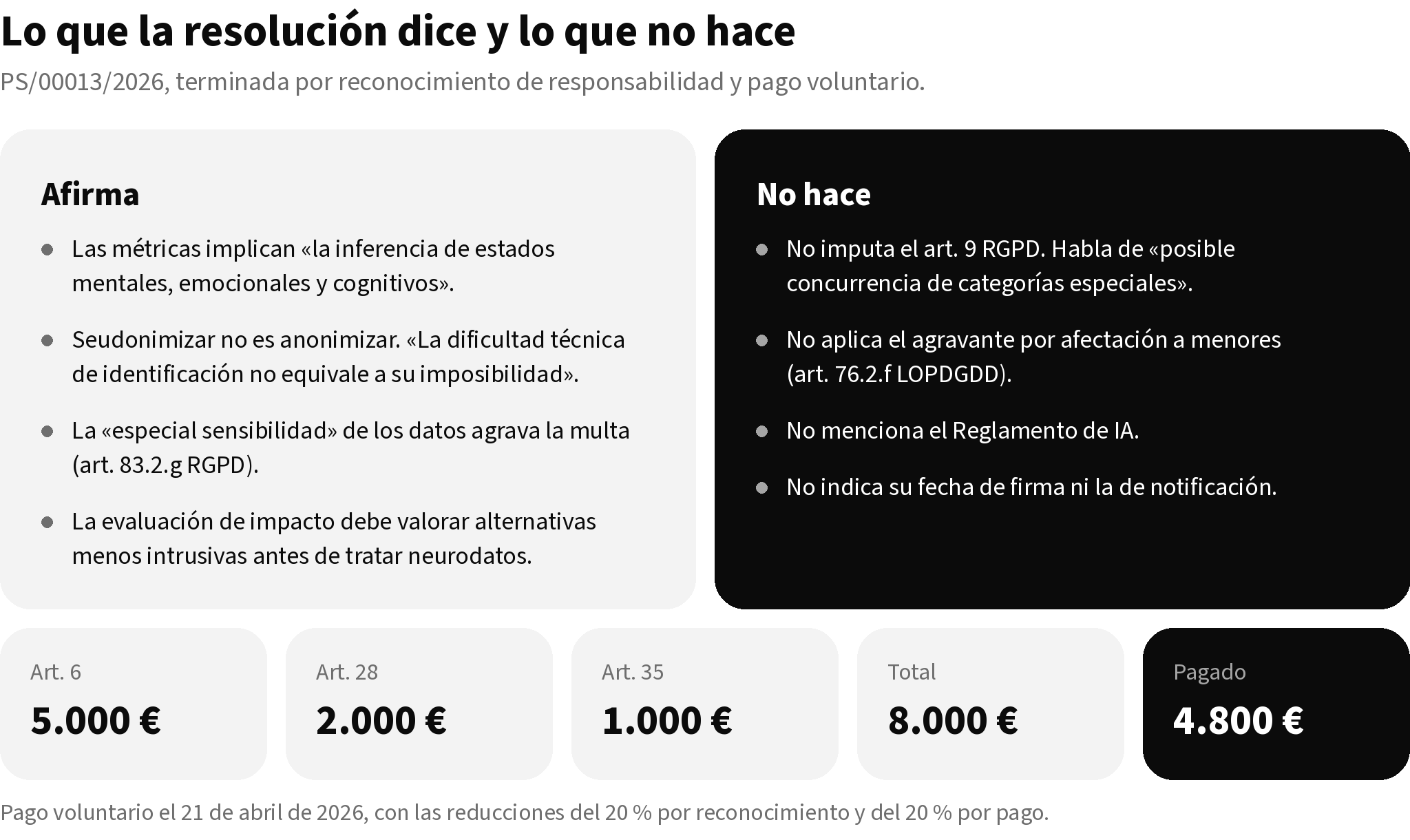
El caso empezó de oficio. El 10 de octubre de 2024 la Dirección de la Agencia abrió una investigación sobre la actividad de la empresa en neurotecnología, y el acuerdo de inicio llegó el 9 de abril de 2026. Imputaba tres infracciones del RGPD, la del artículo 6 por falta de base jurídica válida (5.000 euros), la del artículo 28 por recurrir a subencargados sin autorización ni contrato (2.000 euros) y la del artículo 35 por una evaluación de impacto deficiente (1.000 euros). Bitbrain pagó el 21 de abril con las dos reducciones del 20 % y la sanción quedó en 4.800 euros. Debe acreditar en tres meses que ha corregido el tratamiento. Por el camino, la empresa aportó sus propias cifras, 1.316 personas y 6.558 sesiones en los estudios que hace ella misma, y otras 7.706 sesiones en los laboratorios que vende a sus clientes, grabadas desde 2021.
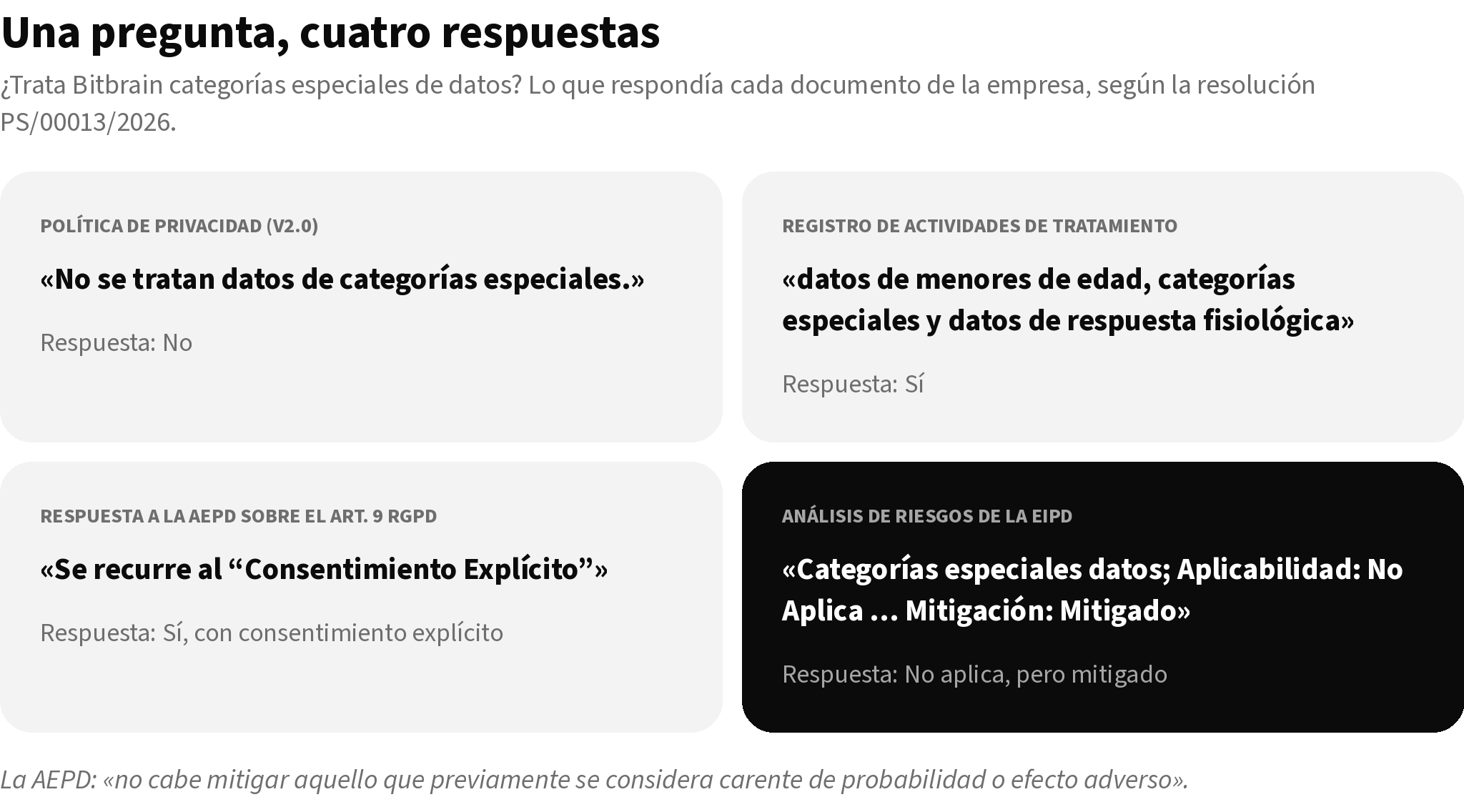
Lo más útil del expediente es lo que cada documento de la empresa decía sobre la misma cuestión. La política de privacidad negaba las categorías especiales. El registro de actividades de tratamiento las incluía, junto a los datos de menores de edad. A la pregunta de la Agencia sobre la excepción del artículo 9 que permitía tratarlas, Bitbrain respondió que recurría al «Consentimiento Explícito». Y el análisis de riesgos que acompañaba a la evaluación de impacto despachaba las categorías especiales como «No Aplica», con riesgo bajo, y aun así las marcaba como «Mitigado». La Agencia lo resume en una frase difícil de mejorar. No cabe mitigar aquello que previamente se considera carente de probabilidad o efecto adverso.
No es que nadie lo hubiera advertido. Una auditoría de 2024 ya pedía corregir los errores de la política de privacidad y separar el consentimiento por finalidades. La empresa nombró delegado de protección de datos en enero de 2023, pero la evaluación de impacto seguía siendo la de 2019, hecha sin él y nunca actualizada.
Detrás de las contradicciones hay un error de concepto. Bitbrain consideraba anónimas las propias métricas, y con ellas los datos que sus clientes subían a la nube. La Agencia comprobó que las métricas podían verse participante a participante, a través del identificador que las vinculaba a la base de datos de voluntarios. Eso es seudonimizar, no anonimizar, y los datos seudonimizados siguen siendo personales cuando pueden atribuirse a alguien con información adicional, como recuerda el considerando 26 del RGPD. «La dificultad técnica de identificación no equivale a su imposibilidad», dice la resolución (página 34). La propia empresa lo acabó admitiendo. Tras el primer requerimiento revisó con su delegado la guía sobre neurodatos que la AEPD y el Supervisor Europeo publicaron en 2024 y concluyó que sus datos estaban «pseudoanonimizados». De ese error salió la segunda infracción. Si los datos eran anónimos, no hacía falta contrato de encargo con los clientes ni autorización para alojarlos en servidores de Amazon y DigitalOcean. Como no lo eran, esa cadena quedó sin la cobertura que exige el artículo 28.
La primera infracción, y la más cara, está en el consentimiento. El voluntario marcaba una sola casilla, la de la «Realización de Estudios de evaluación de respuesta fisiológica». Pero el registro de actividades y las condiciones de la plataforma en la nube añadían otra finalidad, el uso de los datos para «la mejora de algoritmos, análisis comparativo, estadísticas, minería de datos». Para la Agencia, ese consentimiento no era específico, porque no cubría cada finalidad, ni informado, porque no decía que se trataban datos biométricos ni que podía retirarse. Y la mejora o el entrenamiento de algoritmos tampoco podía ampararse en la ejecución de un contrato, porque no era necesaria para el estudio. El formulario de inscripción completaba el cuadro con una invitación, «Cuantos más campos rellenes, más posibilidades de participar», junto a los ingresos familiares, el estado civil o el número de hijos. La Agencia lo valora en contra del principio de minimización.
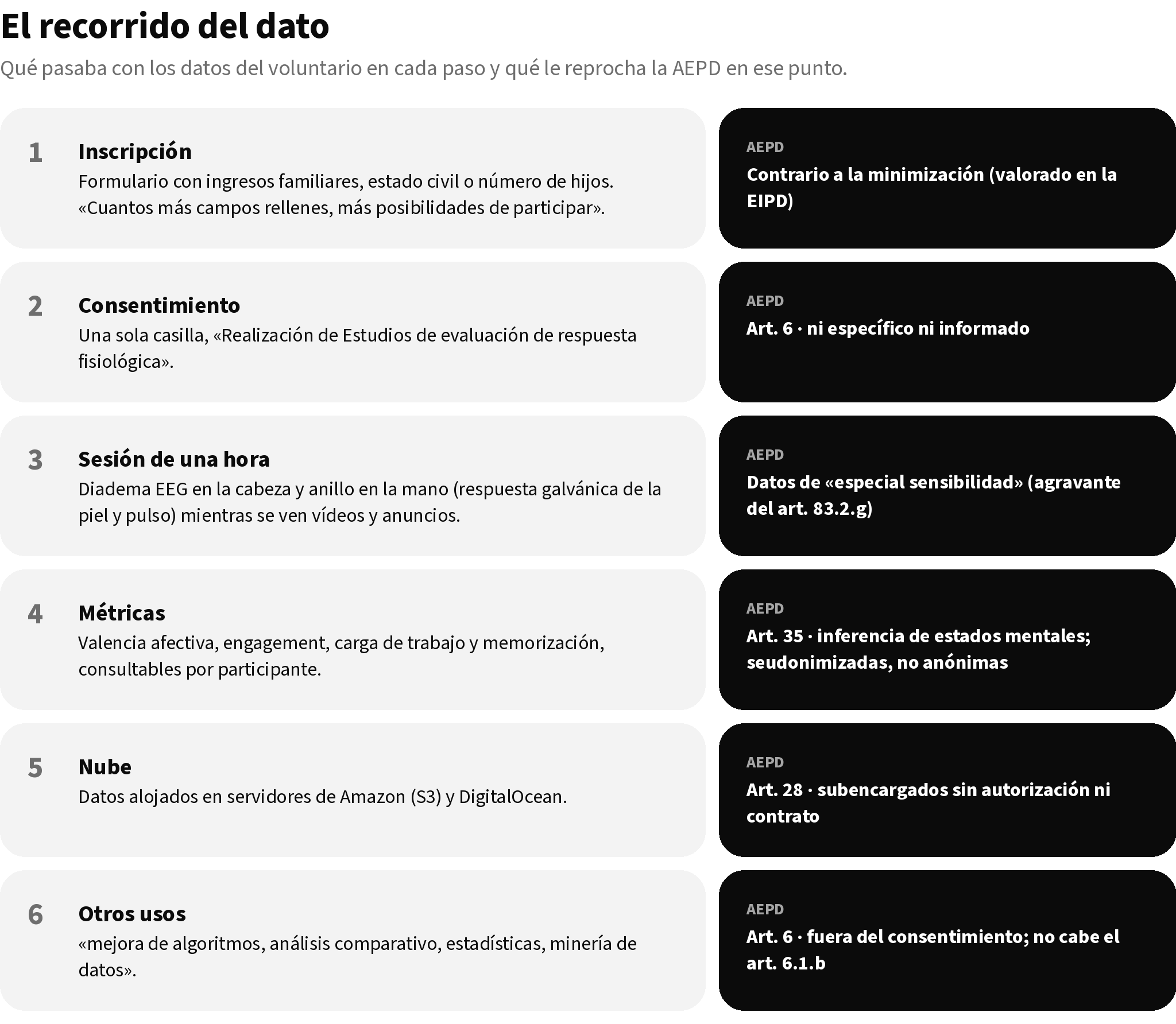
La tercera infracción, la evaluación de impacto, es donde la resolución dice lo más interesante sobre los neurodatos. Allí aparece la frase de las inferencias sobre estados mentales, y allí la Agencia exige el juicio de necesidad que el documento de Bitbrain no hacía, con una cita de la guía de 2024. Quien se plantee tratar neurodatos debe valorar si la finalidad justifica un tratamiento «extremadamente invasivo y sensible, que afecta al aspecto más íntimo de la vida de un individuo» (página 49). La Agencia subraya que la evaluación no analizaba ninguna alternativa menos intrusiva. Una evaluación que solo prevé tres medidas genéricas para un riesgo inherente calificado de alto, y que da por inaplicable el riesgo de reidentificación, no supera ese examen.
Y aquí está la paradoja de la resolución. La Agencia describe unos datos que permiten inferir el estado físico o mental de las personas, los califica de «especial sensibilidad» y los usa como factor de graduación de la multa. Pero no da el paso del artículo 9. Habla de la «posible concurrencia de categorías especiales» (página 50) y de datos que «podrían incluir» información de especial sensibilidad. Tiene una explicación técnica. El artículo 9 del RGPD solo protege los datos biométricos cuando se tratan para identificar a una persona, y un electroencefalograma de neuromarketing no busca identificar a nadie, así que la vía sería la de los datos de salud, y eso depende de qué se infiera y para qué. El Tribunal de Justicia de la UE, sin embargo, ha dicho que no puede quedar fuera del régimen reforzado el tratamiento de datos que puedan desvelar indirectamente información sensible (OT, C-184/20, apartado 127, reiterado en Lindenapotheke, C-21/23, apartado 82). En mi lectura, con esa jurisprudencia había margen para sostener el artículo 9. La resolución no explica por qué no lo hizo.
Se puede objetar que no hacía falta. Y es una objeción razonable. Si el consentimiento ya fallaba por no ser específico ni informado, imputar además el artículo 9 habría exigido probar inferencias concretas sobre la salud de personas concretas, en un expediente que la empresa cerró pagando. Pero la calificación no es un detalle. Determina qué base jurídica cabe, si el consentimiento debe ser explícito y qué evaluación de impacto se exige, y la resolución deja abierta la pregunta que más interesa a todo el sector. Tampoco aplica el agravante por afectación a menores, aunque el formulario preveía la autorización de padres o tutores y la base de datos recogía los datos del tutor cuando el participante era menor. No consta cuántos menores participaron.
El importe merece una lectura serena. Los 4.800 euros equivalen a algo menos de 3,70 euros por cada una de las 1.316 personas afectadas, para una empresa que facturó 1,33 millones de euros en 2024. Un artículo patrocinado por Bitbrain en un medio local de Zaragoza hablaba en 2025 de una compensación mínima de 15 euros por sesión. La comparación es llamativa, pero la cuantía responde a las reglas de graduación y a un pago voluntario con reducciones, no a una valoración de lo que vale un electroencefalograma.
La resolución tampoco menciona el Reglamento de IA. Bitbrain dijo a la Agencia que su plataforma no incorpora ningún componente de inteligencia artificial, aunque la evaluación de impacto de 2019 preveía «opcionalmente» usarla para analizar los datos a nivel poblacional. Con un procesamiento de señal, sin IA, el Reglamento no entra. Pero cambiemos un solo elemento. La misma métrica de valencia, calculada por un sistema de IA y aplicada a los alumnos de un aula o a los empleados de una oficina, entraría en la prohibición del artículo 5.1.f, que desde el 2 de febrero de 2025 impide usar IA para inferir emociones en el trabajo y en los centros educativos, salvo por motivos médicos o de seguridad. Las directrices de la Comisión ponen precisamente como ejemplo prohibido inferir el interés y la atención de los estudiantes. Y la propia resolución cita la educación y los recursos humanos entre los ámbitos a los que se aplica la neurociencia de la empresa. En el neuromarketing con voluntarios pagados no hay prohibición, pero el dato y la métrica serían los mismos.
Para cualquier empresa que mida el cuerpo para saber qué siente alguien, la resolución funciona como una lista de comprobación. Basta con preguntarse si la política de privacidad dice lo mismo que el registro de actividades y que la evaluación de impacto; si cada finalidad, del estudio a la mejora de algoritmos, tiene su propio consentimiento; si lo que llamamos anónimo resiste que alguien pueda ver la métrica de un participante concreto; si cada proveedor de la nube está autorizado y contratado como subencargado; y si la evaluación de impacto se ha rehecho con el delegado de protección de datos y con la guía de 2024 sobre la mesa.
«No se tratan datos de categorías especiales.» La AEPD no ha dicho que esa frase sea falsa, pero tampoco la ha dejado en pie. Ha escrito que lo que sale de la diadema no es un indicador técnico, sino una inferencia sobre lo que pasa dentro de una cabeza. Para el voluntario que pasó una hora viendo anuncios con ella puesta, su valencia afectiva no era una estadística. Era lo que sentía.
Whatever pops into your head. The AEPD’s first sanction regarding neurodata
The Spanish Data Protection Agency has fined Bitbrain, a neurotechnology company based in Zaragoza, for the way it processed the electroencephalograms of volunteers in its neuromarketing studies, and although it has not fined the company for processing special categories of data, it has stated in writing that what these metrics measure are inferences about mental states.
‘No special categories of data are processed.’ This is how the list of data in the privacy policy that Bitbrain provided to those signing up for its neuromarketing studies ended. The information sheet explained the rest. The volunteer would watch various videos and adverts for around an hour, wearing a ring on their hand to record skin response and heart rate, and a headband to record brain signals. Four metrics were derived from that signal: affective valence, engagement (involvement with what is being viewed), cognitive load and memorisation. The first, for example, compares the activity of two frontal regions of the brain; an asymmetry which, according to the company itself, the scientific literature links to positive or negative emotions.
Resolution PS/00013/2026, published by the AEPD on 12 November 2026, does not contradict that statement. It does not accuse Bitbrain of unlawfully processing special categories of data. Nor, however, does it endorse it. In the Agency’s view, these metrics ‘do not constitute mere technical indicators, but rather involve the inference of mental, emotional and cognitive states’ based on physiological or neural signals, and may reveal information about a person’s health or cognitive functioning (page 44). This is the Agency’s first penalty decision focusing on neurodata (data derived from brain or nervous system activity, and what is inferred from them). There is no record of any previous AEPD decision concerning electroencephalography or neurotechnology, although the Agency itself has not presented it as such.
A word of warning before we continue. This is a settlement based on an admission of liability and voluntary payment. Bitbrain paid the fine and did not submit any defence, so the facts and their classification are those set out in the initial agreement, without the cross-examination that would have taken place in a full proceedings. Furthermore, the decision does not state when it was served, and there is no public record of any appeal having been lodged.
The case was initiated ex officio. On 10 October 2024, the Agency’s Management opened an investigation into the company’s activities in neurotechnology, and the initial settlement agreement was reached on 9 April 2026. It alleged three infringements of the GDPR: one under Article 6 for lack of a valid legal basis (5,000 euros), one under Article 28 for using sub-processors without authorisation or a contract (2,000 euros) and one under Article 35 for an inadequate data protection impact assessment (1,000 euros). Bitbrain paid the fine on 21 April, benefiting from two 20 per cent reductions, bringing the total to 4,800 euros. It must demonstrate within three months that it has rectified the data processing. Along the way, the company provided its own figures: 1,316 people and 6,558 sessions in the studies it conducts itself, and a further 7,706 sessions in the laboratories it sells to its clients, recorded since 2021.
The most useful aspect of the case file is what each of the company’s documents stated on the same issue. The privacy policy denied the existence of special categories. The record of processing activities included them, alongside data relating to minors. In response to the Agency’s question regarding the exception under Article 9 that permitted their processing, Bitbrain replied that it relied on ‘Explicit Consent’. And the risk analysis accompanying the data protection impact assessment dismissed special categories as ‘Not Applicable’, with low risk, and even then marked them as ‘Mitigated’. The Agency sums it up in a phrase that could hardly be better put. One cannot mitigate something that is previously considered to have no likelihood or adverse effect.
It’s not as if nobody had pointed this out. An audit in 2024 had already called for the errors in the privacy policy to be corrected and for consent to be separated by purpose. The company appointed a data protection officer in January 2023, but the data protection impact assessment was still the one from 2019, carried out without him and never updated.
Behind these contradictions lies a conceptual error. Bitbrain considered its own metrics to be anonymous, and by extension the data that its clients uploaded to the cloud. The Agency found that the metrics could be viewed on a participant-by-participant basis, via the identifier linking them to the volunteer database. This is pseudonymisation, not anonymisation, and pseudonymised data remains personal data when it can be attributed to an individual with additional information, as set out in Recital 26 of the GDPR. ‘The technical difficulty of identification does not equate to its impossibility,’ states the decision (page 34). The company itself eventually admitted this. Following the first formal notice, it reviewed, together with its data protection officer, the guidance on neurodata published by the AEPD and the European Data Protection Supervisor in 2024 and concluded that its data was ‘pseudo-anonymised’. This error led to the second infringement. If the data had been anonymous, there would have been no need for a data processing agreement with clients or authorisation to host it on Amazon and DigitalOcean servers. As it was not, that chain of processing was left without the safeguards required by Article 28.
The first infringement – and the most costly one – relates to consent. The volunteer ticked a single box, that for ‘Conducting studies to assess physiological responses’. However, the activity log and the terms and conditions of the cloud platform added another purpose: the use of the data for ‘algorithm improvement, comparative analysis, statistics and data mining’. In the Agency’s view, this consent was neither specific – as it did not cover each individual purpose – nor informed – as it did not state that biometric data was being processed or that consent could be withdrawn. Furthermore, the improvement or training of algorithms could not be justified on the grounds of the performance of a contract, as it was not necessary for the study. The registration form rounded off the picture with an invitation: ‘The more fields you fill in, the greater your chances of taking part’, alongside questions on household income, marital status and the number of children. The Agency considers this to be contrary to the principle of data minimisation.
The third infringement, the impact assessment, is where the decision makes the most interesting points regarding neurodata. It is here that the phrase regarding inferences about mental states appears, and it is here that the Agency demands the assessment of necessity that Bitbrain’s document failed to provide, citing the 2024 guidance. Anyone considering processing neurodata must assess whether the purpose justifies ‘extremely invasive and sensitive’ processing, ‘which affects the most intimate aspects of an individual’s life’ (page 49). The Agency emphasises that the assessment did not analyse any less intrusive alternatives. An assessment that provides for only three generic measures for an inherent risk classified as high, and which considers the risk of re-identification to be inapplicable, does not pass that test.
And herein lies the paradox of the decision. The Agency describes data that allow inferences to be drawn about individuals’ physical or mental state, classifies them as ‘particularly sensitive’ and uses them as a factor in determining the level of the fine. Yet it does not take the step required by Article 9. It refers to the ‘possible overlap of special categories’ (page 50) and to data that ‘could include’ highly sensitive information. There is a technical explanation for this. Article 9 of the GDPR only protects biometric data when it is processed to identify a person, and a neuromarketing electroencephalogram does not seek to identify anyone; therefore, the relevant category would be health data, and this depends on what is inferred and for what purpose. The Court of Justice of the EU, has, however, ruled that the processing of data which may indirectly reveal sensitive information cannot be excluded from the enhanced regime (OT, C-184/20, paragraph 127, reiterated in Lindenapotheke, C-21/23, paragraph 82). In my view, given that case law, there was scope to uphold Article 9. The ruling does not explain why it did not do so.
It could be argued that this was unnecessary. And that is a reasonable objection. If consent was already found to be lacking because it was neither specific nor informed, to additionally invoke Article 9 would have required proving specific inferences regarding the health of specific individuals, in a case that the company settled by paying a fine. But the legal classification is not a mere detail. It determines which legal basis applies, whether consent must be explicit and what impact assessment is required, and the ruling leaves open the question of greatest interest to the entire sector. Nor does the aggravating circumstance of the involvement of minors apply, even though the form provided for authorisation from parents or guardians and the database recorded the guardian’s details when the participant was a minor. It is not clear how many minors took part.
The amount warrants careful consideration. The 4,800 euros equates to just under 3.70 euros for each of the 1,316 people affected, for a company that had a turnover of 1.33 million euros in 2024. An article sponsored by Bitbrain in a local Zaragoza publication in 2025 mentioned a minimum compensation of 15 euros per session. The comparison is striking, but the amount is based on the sliding-scale rules and a voluntary payment with reductions, not on an assessment of what an electroencephalogram is worth.
Nor does the ruling mention the AI Regulation. Bitbrain told the Agency that its platform does not incorporate any artificial intelligence components, although the 2019 impact assessment envisaged using it ‘optionally’ to analyse data at a population level. With signal processing, without AI, the Regulation does not apply. But let us change just one element. The same valence metric, calculated by an AI system and applied to pupils in a classroom or employees in an office, would fall under the prohibition in Article 5.1.f, which, from 2 February 2025, prohibits the use of AI to infer emotions in the workplace and in educational institutions, except for medical or safety reasons. The Commission’s guidelines specifically cite inferring pupils’ interest and attention as a prohibited example. And the resolution itself lists education and human resources amongst the areas to which corporate neuroscience applies. In neuromarketing involving paid volunteers, there is no ban, but the data and metrics would be the same.
For any company that measures the body to determine how someone is feeling, the resolution serves as a checklist. One need only ask whether the privacy policy states the same as the record of activities and the data protection impact assessment; whether each purpose – from the study to the improvement of algorithms – has its own consent; whether what we call ‘anonymous’ holds up if someone were to view the metrics of a specific participant; whether each cloud provider is authorised and contracted as a sub-processor; and whether the data protection impact assessment has been redone with the data protection officer and the 2024 guidelines on the table.
‘No special categories of data are processed.’ The AEPD has not stated that this sentence is false, but nor has it upheld it. It has stated that what is recorded by the headband is not a technical indicator, but an inference about what is going on inside a person’s mind. For the volunteer who spent an hour watching adverts whilst wearing it, their emotional response was not a statistic. It was what they felt.